Information
Although Buddhist festivals have centuries-old tradition, the first conference of the World Fellowship of Buddhists held in Sri Lanka in 1950 formalized the decision to celebrate Vesak as the Buddha's birthday across multiple Buddhist countries. The resolution that was adopted at the World Conference reads as follows:
That this Conference of the World Fellowship of Buddhists, while recording its appreciation of the gracious act of His Majesty, the Maharaja of Nepal in making the full-moon day of Vesak a Public Holiday in Nepal, earnestly requests the Heads of Governments of all countries in which large or small number of Buddhists are to be found, to take steps to make the full-moon day in the month of May a Public Holiday in honour of the Buddha, who is universally acclaimed as one of the greatest benefactors of Humanity.[18]
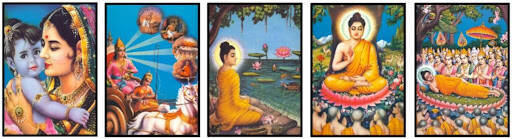
On Vesak Day, Buddhists around the world commemorate three major events in the life of Buddha Gautama: his birth, enlightenment, and passing (Parinirvana). As Buddhism spread from India it was assimilated into many foreign cultures, and consequently Vesak is celebrated in many different ways all over the world. In India, Vaishakh Purnima day is also known as Buddha Jayanti day and has been traditionally accepted as Buddha's birth day.
In 2000, the United Nations (UN) resolved to internationally observe the day of Vesak at its headquarters and offices.
The month of May usually has one full moon, but as there are 29.5 days between full moons, occasionally there are two. If there are two full moons during the month of May, some countries (including Sri Lanka, Cambodia and Malaysia) celebrate Vesak on the first full moon, while others (Thailand, Singapore) celebrate the holiday on the full moon of 4th lunar month. The difference also manifests in the observance of other Buddhist holidays, which are traditionally observed at the local full moon.[20]
On Vesak, devout Buddhists and followers alike assemble in their various temples before dawn for the ceremonial and honorable hoisting of the Buddhist flag and the singing of hymns in praise of the holy triple gem: The Buddha, The Dharma (his teachings), and The Sangha (his disciples). Devotees may bring simple offerings of flowers, candles and joss-sticks to lay at the feet of their teacher. These symbolic offerings are to remind followers that just as the beautiful flowers would wither away after a short while, and the candles and joss-sticks would soon burn out, so too is life subject to decay and destruction. Devotees are enjoined to make a special effort to refrain from killing of any kind. They are encouraged to partake only of vegetarian food for the day. In some countries, notably Sri Lanka, two days are set aside for the celebration of Vesak, and all liquor shops and slaughter houses are closed by government decree during the two days.
Also birds, insects and animals are released by the thousands in what is known as life release to give freedom to those who are in captivity, imprisoned, or tortured against their will. (The practice, however, is banned in some countries such as Singapore, as the released animals are unable to survive long-term or may adversely impact the local ecosystem if they do.)[21]
Some devout Buddhists will wear simple white clothing and spend the whole day in temples with renewed determination to observe the eight precepts.
Young novice monk on Vesak Day Parade

Devout Buddhists undertake to lead a noble life according to the teaching by making daily affirmations to observe the Five Precepts. However, on special days, notably new moon and full moon days, they observe the eight precepts to train themselves to practice morality, simplicity, and humility.
Some temples also display a small statue of the Buddha in front of the altar in a small basin decorated with flowers, and filled with water or sweet tea for devotees to pour over the statue. This is symbolic of the cleansing of a practitioner's bad karma, and to reenact the events following the Buddha's birth, when devas and spirits made heavenly offerings to him.
Devotees are expected to listen to talks given by monks. On this day, monks will recite verses uttered by the Buddha twenty-five centuries ago to invoke peace and happiness for the government and the people. Buddhists are reminded to live in harmony with people of other faiths and to respect the beliefs of other people as the Buddha taught.
Bringing happiness to others
Video Korean Buddhist monks perform ritual dances and music on Buddha's Birthday.
Celebrating Vesak also means making special efforts to bring happiness to the unfortunate like the aged, the disabled, and the sick. To this day, Buddhists will distribute gifts in the form of cash, or volunteering in various charitable homes throughout the country. Vesak is also a time for great joy and happiness, expressed not by pandering to one's appetites, but by concentrating on useful activities such as decorating and illuminating temples, or painting and creating exquisite scenes from the life of the Buddha for public dissemination. Devout Buddhists also vie with one another to provide refreshments and vegetarian food to followers who visit the temple to pay homage to the Enlightened One